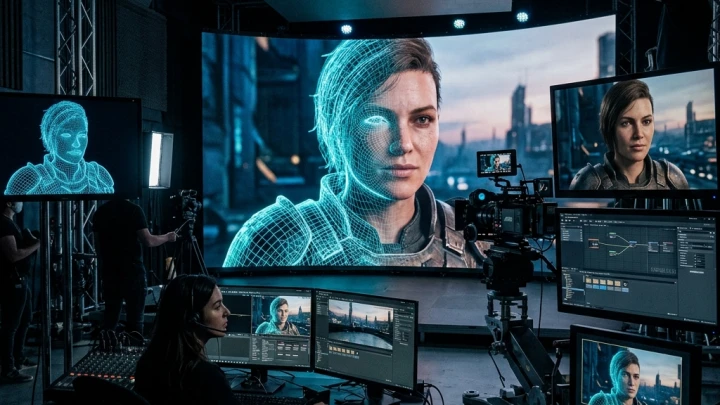
The entertainment industry is experiencing a massive structural shift in how digital avatars and virtual assets are produced for film, gaming, and interactive media. Historically, building high-fidelity characters required a massive investment of manual labor, motion capture studio time, and complex rigging processes. Today, advanced artificial intelligence models are fundamentally altering this pipeline by automating the reconstruction of complex geometries. At the forefront of this shift is Neural4D, an advanced 3D generative system jointly developed by Nanjing University, DreamTech, Oxford University, and Fudan University. This academic and commercial collaboration has yielded a platform that drastically reduces the technical overhead of virtual production.
By leveraging advanced neural radiance fields and sparse attention mechanisms, studios can now use Neural4D to generate digital avatars from 2D images with unprecedented speed and accuracy. This capability bypasses the need for multi-camera photogrammetry rigs, allowing directors and character artists to prototype and deploy highly detailed virtual characters in a fraction of the time. The implications for the celebrity news sector and virtual influencer market are profound, as the barrier to creating realistic digital doubles drops significantly.
The Evolution of Virtual Production and Character Assets
Virtual production has matured rapidly over the past decade, driven heavily by real-time rendering engines like Unreal Engine and advanced motion tracking technologies. However, the initial step of the process, creating the 3D asset itself, has remained a notorious bottleneck. A standard photorealistic digital avatar requires modeling the base mesh, establishing the topology, baking high-resolution textures, and configuring Physically Based Rendering (PBR) materials for realistic light interaction.
When creating digital doubles of celebrities or original characters for immersive media, human artists must spend weeks refining skin shaders, hair physics, and facial blend shapes. The cost and timeline associated with this manual creation limit the scale at which studios can deploy interactive characters.
The introduction of large-scale 3D generative models addresses this exact inefficiency. By training on vast datasets of 3D objects, human scans, and spatial data, modern AI frameworks can infer 3D structure from single or multiple flat images. This shifts the artist’s role from manual vertex pushing to high-level direction and curation, fundamentally reshaping the economics of virtual production.
Core Technology: Direct3D-S2 Architecture
The engine driving this new wave of asset generation relies on specialized neural architectures designed specifically for spatial data. The Direct3D-S2 architecture represents a major leap in how machines interpret and construct three-dimensional space from two-dimensional inputs.
Unlike early generative models that produced noisy point clouds or non-manifold meshes, Direct3D-S2 outputs clean, production-ready quad-dominant topology. This is achieved through a multi-stage generation process that separates structural geometry from surface detail.
Spatial Sparse Attention (SSA) Mechanism
A critical component of this architecture is the Spatial Sparse Attention (SSA) mechanism. Traditional attention mechanisms in transformer models scale quadratically with the input sequence length, making high-resolution 3D volume processing computationally prohibitive. SSA solves this by restricting the attention calculation to spatially relevant features within the latent volume.
This localization allows the network to process much higher resolution 3D structures without running out of memory. For character generation, this means the model can allocate dense geometric detail to highly complex areas like the face and hands, while maintaining a lighter polygon count on smoother surfaces like clothing. The result is a highly optimized asset that performs efficiently in real-time virtual production environments.
PBR Material Generation and Texture Baking
Geometry is only half of the equation in digital avatar creation. For a character to look realistic under the dynamic lighting of a virtual production LED volume, it requires a complete set of PBR textures.
Generative systems now automate the extraction and assignment of these materials. When processing a reference image, the neural network separates the visual data into intrinsic components: albedo (base color), roughness, metallic, and normal maps. This intrinsic decomposition ensures that baked-in lighting and shadows from the original 2D reference are removed.
When the resulting avatar is imported into Unreal Engine or Maya, it reacts accurately to the studio lighting environment, reflecting and absorbing light exactly as a physical object would. This capability is essential for seamlessly blending virtual characters with live-action actors in celebrity media and hybrid film projects.
Technical Comparison: Traditional Pipeline vs Generative 3D
The impact of integrating automated 3D generation into an entertainment pipeline is best understood by looking at the specific workflow differences.
| Metric | Traditional Manual Pipeline | Generative AI Pipeline (Direct3D-S2) |
| Asset Creation Time | 2 to 4 weeks per character | 5 to 15 minutes |
| Initial Input Required | Multi-angle photogrammetry rig | Single or sparse 2D images |
| Topology Structure | Manually retopologized | Auto-generated quad-dominant mesh |
| Texture Maps | Hand-painted or projected PBR | AI-decomposed intrinsic PBR |
| Scaling Capability | Highly resource intensive | Highly scalable |
This table clearly illustrates the efficiency gains across every major phase of character production. The reduction in time from weeks to minutes allows production teams to iterate rapidly, testing multiple character variations within a single afternoon.
Scaling 3D Content Creation and Community Collaboration
As the barriers to creating 3D assets continue to fall, a robust ecosystem of shared resources and collaborative platforms is emerging. For independent creators, mid-sized studios, and developers building interactive celebrity experiences, having access to a diverse library of base models accelerates the development process even further.
Many creators now access open-source 3D models to find pre-rigged skeletons, generic base meshes, and environment props. These community-driven repositories serve as the foundation for complex virtual production scenes. An artist can download a generic environment from a shared directory, use automated AI tools to generate specific hero characters, and assemble the final scene in a real-time engine with unprecedented efficiency.
This collaborative approach democratizes high-end visual effects, making tools and assets that were once exclusive to major Hollywood studios available to independent media companies and digital publishers.
Final Thoughts on the Future of Digital Avatars
The rapid advancement of AI-driven 3D reconstruction is reshaping the landscape of entertainment media, virtual production, and digital celebrity culture. The ability to rapidly generate high-fidelity, production-ready digital avatars directly from 2D references eliminates long-standing workflow bottlenecks. As neural architectures like Direct3D-S2 continue to refine the generation of complex geometry and intrinsic PBR materials, the quality of automated assets will soon match the output of extensive manual modeling. This technological shift empowers creators to focus entirely on storytelling, performance, and artistic direction, establishing a new standard for interactive content creation in the years ahead.