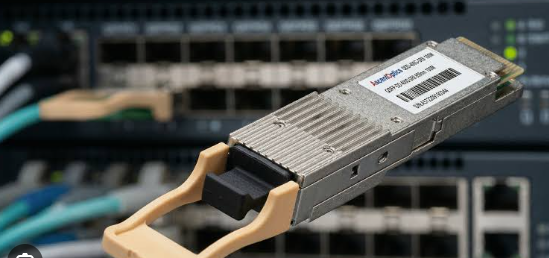
Modern AI training workloads require extremely fast and scalable interconnects to handle massive data exchange between thousands of GPUs. In this environment, 200G QSFP56 InfiniBand modules play a critical role in enabling low-latency, high-bandwidth communication inside distributed computing systems. These modules are widely deployed in InfiniBand HDR networks, where performance and efficiency are essential for large-scale model training and inference tasks.
In AI data centers built around GPU clusters, network bandwidth often becomes the limiting factor in overall system performance. 200G QSFP56 InfiniBand modules help eliminate this bottleneck by providing 200Gbps connectivity per port, allowing GPUs, switches, and storage systems to communicate at extremely high speeds. This ensures that distributed workloads remain synchronized and that training efficiency is maximized across all compute nodes.
As AI models continue to grow in size and complexity, the demand for scalable and efficient interconnects increases significantly. 200G QSFP56 InfiniBand modules offer a balanced solution between cost, performance, and deployment simplicity, making them one of the most widely used optical transceiver types in modern InfiniBand HDR AI clusters.
Understanding 200G QSFP56 SR4 Architecture
Parallel Optical Design for High Throughput
The 200G QSFP56 SR4 module is built on a parallel optics architecture that uses four independent transmit and receive lanes, each operating at 50Gbps using PAM4 modulation. This design enables a total aggregate bandwidth of 200Gbps while maintaining efficient signal integrity over short distances. The SR4 standard is optimized for multimode fiber transmission, making it ideal for intra-data center and intra-rack connections.
The module operates at an 850nm wavelength using VCSEL (Vertical-Cavity Surface-Emitting Laser) technology, which is well-suited for cost-effective short-reach applications. With a typical transmission distance of up to 100 meters over OM4 multimode fiber, SR4 modules are widely used in high-density AI environments where devices are located in close proximity.
MTP/MPO-12 Connectivity and Physical Integration
A key feature of the 200G QSFP56 SR4 design is its use of MTP/MPO-12 connectors, which support the simultaneous transmission of multiple optical lanes through a single compact interface. This significantly simplifies cabling complexity in data centers while improving airflow and rack organization. The MPO-12/APC interface also enhances signal alignment and reduces insertion loss, which is critical for maintaining stable high-speed transmission.
Role of 200G SR4 in InfiniBand HDR AI Clusters
High-Bandwidth Fabric for GPU Communication
In InfiniBand HDR AI clusters built by NVIDIA, the network fabric plays a central role in ensuring efficient GPU-to-GPU communication. InfiniBand HDR architecture relies heavily on 200G links to deliver the bandwidth required for distributed deep learning workloads. In this context, 200G SR4 modules provide the essential short-reach connectivity needed between leaf switches and compute nodes.
These optical modules enable a non-blocking network fabric where data can move freely between GPUs without congestion. This is especially important in AI training scenarios involving large-scale parallel computation, where synchronization delays can significantly impact overall performance. By supporting high-throughput links, SR4 modules help maintain consistent data flow across the cluster.
Low Latency and Predictable Performance
One of the most important requirements in AI clusters is predictable low latency. InfiniBand networks are designed to minimize communication overhead, and 200G SR4 modules contribute to this goal by offering direct, short-distance optical paths. Since SR4 operates over multimode fiber with limited reach, signal distortion and latency variability are minimized compared to longer-reach solutions.
This deterministic performance is crucial for workloads such as distributed training of large language models, where thousands of GPUs must exchange gradients simultaneously. Any delay in communication can slow down the entire training pipeline, making high-performance optical interconnects a key infrastructure component.
Advantages of Multimode Fiber in AI Data Centers
Cost-Effective High-Density Deployment
One of the primary advantages of 200G QSFP56 SR4 modules is their compatibility with multimode fiber infrastructure. Many data centers already deploy OM4 multimode cabling, which can support 200G transmission over distances up to 100 meters. This allows operators to upgrade network speed without replacing existing fiber plants, significantly reducing capital expenditure.
Multimode fiber also simplifies installation in high-density environments. Because SR4 modules are designed for short-reach links, cable routing becomes more manageable, and infrastructure complexity is reduced. This is particularly beneficial in AI clusters where thousands of interconnects must be maintained efficiently.
VCSEL-Based Efficiency
The use of 850nm VCSEL technology provides additional cost and power advantages. VCSELs are highly efficient for short-distance optical communication and offer lower manufacturing complexity compared to single-mode laser systems. As a result, SR4 modules provide an optimal balance between performance and operational cost, making them well-suited for large-scale deployment in AI environments.
Cabling and System Design Considerations
MPO-12-Based High-Density Layouts
The use of MPO-12 connectors in 200G SR4 modules enables structured and scalable cabling architectures. In AI data centers, where rack density is extremely high, maintaining organized fiber routing is essential for operational efficiency. MPO-based systems reduce the number of individual fiber strands required, simplifying both installation and maintenance.
Proper polarity management and connector cleanliness are also critical factors in ensuring reliable performance. Even minor contamination in MPO interfaces can lead to signal degradation, making disciplined fiber management practices essential in high-speed InfiniBand environments.
Integration with Leaf-Spine Architectures
In modern leaf-spine network designs, 200G SR4 modules are commonly deployed at the leaf layer to connect compute nodes, while higher-capacity links aggregate traffic toward spine switches. This architecture ensures scalable bandwidth distribution and prevents bottlenecks in AI training workloads.
Because SR4 is optimized for short-reach connections, it fits naturally into rack-level and row-level networking designs. This allows network architects to build modular systems where compute clusters can be expanded without redesigning the entire network topology.
Practical Applications in AI and HPC Environments
200G QSFP56 SR4 modules are widely used in GPU-intensive environments such as AI training clusters, high-performance computing (HPC) systems, and large-scale cloud data centers. In these environments, thousands of nodes must communicate simultaneously, requiring a network fabric that can deliver consistent high bandwidth with minimal latency.
In AI training clusters, SR4 modules enable efficient synchronization between GPUs during model training iterations. In HPC environments, they support scientific simulations and data-intensive workloads that require rapid inter-node communication. In cloud data centers, they help maintain high-speed connectivity between compute and storage layers, ensuring smooth operation of distributed applications.
Conclusion
The 200G QSFP56 SR4 optical transceiver is a foundational component in modern InfiniBand HDR AI clusters. By combining 200Gbps bandwidth, PAM4 modulation, 850nm VCSEL technology, and MPO-12 multimode connectivity, it delivers a highly efficient solution for short-reach high-speed networking.
As AI workloads continue to expand, the importance of scalable and cost-effective interconnects will only increase. 200G SR4 modules provide the performance, reliability, and simplicity required to support next-generation GPU clusters, making them an essential building block in the evolution of high-performance InfiniBand-based data center networks.