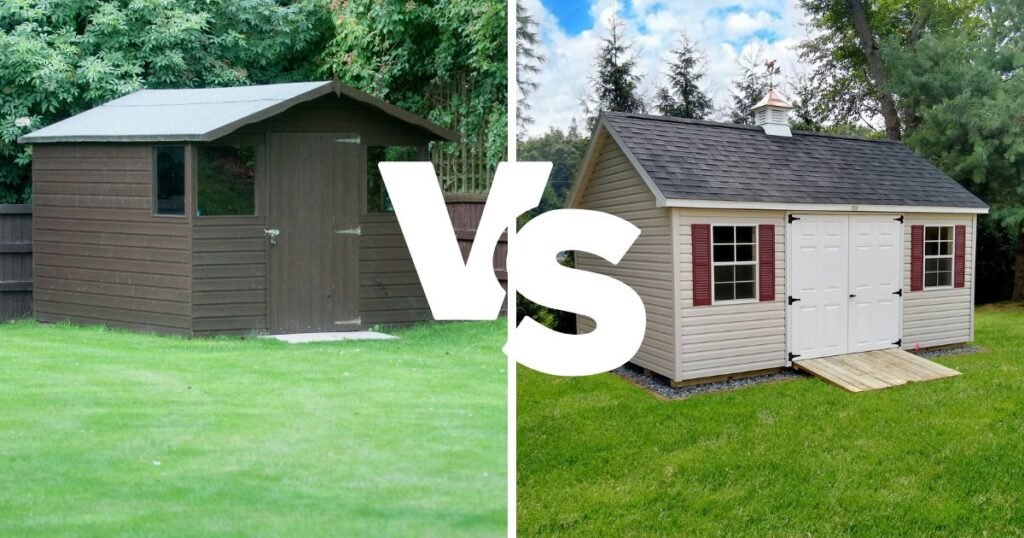
Renters have a complicated relationship with their outdoor spaces. The garden is yours to use and to enjoy, but it is also someone else’s property — which means that the permanent improvements you might make to a garden you owned are either not permitted, not advisable, or simply not worth the investment given the uncertainty of how long you will be there. A beautifully planted border, a carefully laid path, a wooden shed installed on a concrete base: all of these represent real effort and real money that you may ultimately have to leave behind, hand back, or dismantle at the landlord’s request.
This uncertainty shapes the garden decisions of a very large number of people. Around a third of households in England rent their homes, and the proportion is higher in cities and among younger age groups. For many of these households, the garden is a space of genuine potential that goes unrealised because the investment calculus never quite adds up. The outdoor storage problem — having nowhere dry and secure to put garden tools, bikes, seasonal equipment, and the general overflow of household life — is one of the most common and most frustrating aspects of rented garden living, and it is one that a portable plastic or resin building solves rather neatly.
The Portability Advantage
The defining advantage of a plastic garden shed in a rented property is that it does not need to become part of the property. A timber shed installed on a concrete base is a semi-permanent fixture: removing it at the end of a tenancy means dealing with the concrete base, potentially patching the ground, and transporting a structure that may not survive disassembly in good condition. The landlord may have views about its installation; the end of tenancy checkout process will certainly take note of it.
A plastic shed, by contrast, sits on a surface rather than being fixed to one. Most designs are assembled from interlocking panels that can be disassembled and reassembled without specialist tools, making them genuinely transportable between properties. The base it sits on can be paving slabs or compacted gravel rather than concrete — materials that can be lifted and restored without leaving any permanent trace. When you move, the shed moves with you. This is not just a practical convenience; it also resolves most of the permission and dilapidations questions that arise with more permanent garden structures.
What You Can and Cannot Do in a Rented Garden
The legal position on making changes to rented gardens varies depending on the tenancy agreement, but the general principle is that structural or permanent changes require landlord consent, while non-permanent additions are typically at the tenant’s discretion. A shed that is bolted to a concrete foundation it has created is in a different legal category from one that sits on existing paving and is held together by its own weight and a few fixings into the panel joints.
If you are uncertain about where a proposed garden building falls in relation to your tenancy agreement, the practical advice is to ask the landlord or letting agent before installing anything, and to document the conversation. Tenant rights guidance around garden alterations and outdoor improvements is worth reviewing if you want a clear understanding of the general legal framework, though the specific terms of your tenancy always take precedence.
In practice, most landlords are not opposed to a portable storage building that protects the tenant’s belongings, keeps the garden tidy, and leaves no permanent mark. Presenting the proposal clearly — portable structure, no groundworks, removable at end of tenancy — tends to produce a straightforward yes from all but the most restrictive landlords. Having the conversation in writing, and keeping a record of the response, provides useful protection for both parties.
The Storage Problem Renters Actually Face
The outdoor storage deficit in most rented properties is not abstract. It shows up as bikes in the hallway, garden tools leaning against the kitchen wall, bags of compost in the utility room, barbecues that come inside every winter and take up space that was not available for them, and a general sense that the garden and the house are fighting for the same inadequate volume of covered space. The cumulative effect on quality of daily life is real even when each individual item seems like a minor inconvenience.
A shed with even four to six square metres of floor space resolves the majority of this. Bikes have a home. Tools are dry and accessible without navigating through the kitchen. Seasonal equipment — paddling pools, garden furniture cushions, the barbecue itself — can live outside year-round without deteriorating. The house reclaims the space it was occupying, and the garden becomes a properly functioning outdoor room rather than an overflow storage area with some grass in it.
Choosing the Right Size for a Rented Garden
Rented gardens in the UK tend to be either very small — the narrow strip behind a terraced house — or of medium suburban size, with very large private gardens being less common in the rental stock. The most useful shed sizes for rented properties are therefore typically in the compact to mid-range, where the building provides genuinely useful storage without dominating a garden that may not have a great deal of space to spare.
A 6x4ft structure is the practical minimum for household storage use — large enough for a bike and garden tools alongside a modest collection of other items, but small enough to fit in most gardens without consuming an unreasonable proportion of the usable space. An 8x6ft building starts to feel genuinely spacious and can accommodate most households’ outdoor storage needs comfortably. Anything larger than this is useful primarily for households with specific high-volume storage requirements, or for gardens where the building will serve a secondary purpose beyond storage.
The specific floor plan of the garden matters too: a shed that is taller relative to its footprint uses vertical space efficiently and is better suited to narrow plots than a wider, lower structure. Most plastic garden buildings are available in configurations that include shelving as standard or as an accessory, which significantly increases the effective storage volume without requiring a larger footprint.
Making the Move
For renters who have been managing without outdoor storage and are considering the investment for the first time, the practical question is whether the cost is justified given the uncertainty of tenure. The honest answer is that a quality portable building, bought once and moved between properties, amortises its cost very differently from a fixed structure that stays behind when you leave. Over two or three moves, a well-made portable plastic shed that travels with you is an investment that makes financial sense.
The range of a plastic or resin garden building currently available at Dobbies covers most of the sizes and specifications relevant to a rented garden context, from compact storage units through to buildings large enough to properly solve a household storage problem. Checking the assembly and disassembly instructions before purchasing will confirm whether a specific model is genuinely portable in the way you need it to be.