Most people have a pretty dramatic idea of what a polygraph test looks like. A dim room. A stern examiner. Wires everywhere. Someone sweating under pressure while a needle dances across a chart.
Reality is a bit less theatrical—but not by much.
A polygraph test can feel intense, even if you’ve got nothing to hide. And that’s partly the point. It’s designed to measure how your body reacts when you answer questions, not just what you say. That alone makes people uneasy.
So what actually happens when you sit down for one?
Let’s walk through it the way it really unfolds.
The Setup Feels More Personal Than Technical
Before any wires come out, there’s a conversation.
You don’t just walk in and get hooked up like a machine. The examiner will usually spend a good chunk of time talking with you first. This is called the pre-test phase, and it matters more than most people expect.
They’ll explain how the polygraph works, what it measures, and what the process will look like. It’s not just politeness—they’re setting a baseline for your understanding and comfort level.
Then comes the part that catches people off guard: they go over the questions in advance.
Yes, you’ll usually see the exact questions before the test starts.
For example, if the test is about theft, you might hear something like:
“Have you ever taken something that didn’t belong to you from your workplace?”
They want to make sure you clearly understand each question. No ambiguity. No confusion. That way, any reaction during the test is less likely to be about misunderstanding and more about your internal response.
It’s also when they start watching you—subtly. How you react. Whether you hesitate. If you try to explain things away.
Even sitting in a chair, just talking, the process has already begun.
The Equipment Looks Simpler Than You’d Expect
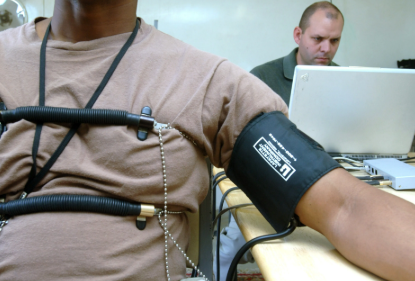
When people imagine a polygraph machine, they often picture something out of a spy movie. In reality, it’s a set of sensors connected to a computer.
You’ll typically have:
- Bands around your chest and abdomen to measure breathing
- A blood pressure cuff on your arm
- Small sensors attached to your fingers to track sweat (skin conductivity)
That’s it. No needles. No pain. Just mildly uncomfortable, like sitting still in a doctor’s office while being monitored.
Once everything is attached, you’re asked to sit as still as possible. Even small movements can affect the readings, so fidgeting isn’t your friend here.
Here’s the thing: the machine doesn’t detect lies directly.
It records physiological changes—heart rate, breathing, sweat. The assumption is that deceptive answers trigger stress responses. Whether that assumption always holds up… well, that’s where debate comes in.
But during the test, that nuance doesn’t really matter. You’re being measured, and you feel it.
The Questions Are More Strategic Than You Think
The questioning phase is where most people expect the “truth or lie” moment. But it’s not that straightforward.
Polygraph tests usually mix different types of questions together.
Some are completely neutral:
“Is your name John?”
“Are you sitting down?”
These help establish a baseline—how your body behaves when you’re relaxed and telling obvious truths.
Then come the relevant questions. These are directly tied to whatever is being investigated.
And then there are control questions. These are the tricky ones.
They’re broad, slightly uncomfortable, and often impossible to answer with a clean “no.” Something like:
“Have you ever lied to get out of trouble?”
Let’s be honest—almost everyone has. The idea is to create a comparison. Your reaction to this kind of question gets weighed against your reaction to the more specific ones.
A typical sequence might feel repetitive. The same questions, asked multiple times, in slightly varied order.
That repetition isn’t accidental. It helps the examiner look for consistent patterns in your responses.
From your side, it can feel oddly stressful. Even if you’re answering truthfully, your brain starts second-guessing itself.
“Am I breathing weird?”
“Was that pause too long?”
“Did that sound suspicious?”
That mental spiral? Very common.
You Don’t Get Instant Results
Despite what movies show, the examiner doesn’t usually lean back and say, “You’re lying,” right after the test ends.
Instead, there’s a review process.
The data collected during the session gets analyzed—sometimes by the examiner, sometimes with software assistance. They’re looking at patterns across multiple questions and responses.
In some cases, you might get a general sense of how things went. In others, you’ll be told the results will come later.
And here’s where things get a bit uncomfortable: the interpretation isn’t purely objective.
Two examiners might look at the same data and come to slightly different conclusions. That’s one of the reasons polygraph tests are controversial and not always admissible in court.
Still, they’re widely used in certain contexts—especially for employment screening in specific fields or internal investigations.
Why Even Truthful People Get Nervous
A common misconception is that only people who are lying feel anxious during a polygraph test.
That’s just not true.
Imagine you’re completely innocent, but the stakes are high. Maybe it’s a job you really want, or a situation where your reputation is on the line.
Your heart rate goes up. Your breathing shifts. You start overthinking every answer.
That physiological response can look a lot like what the test is designed to detect.
Here’s a simple scenario: someone applying for a law enforcement position is asked about past drug use. They’ve never used drugs, but they’re terrified of messing up the test.
When the question comes, their body reacts—not because they’re lying, but because they’re under pressure.
That’s one of the core criticisms of polygraph testing. It doesn’t measure truth directly. It measures stress—and stress doesn’t always equal deception.
Can People Beat a Polygraph Test?
This question comes up a lot, and the honest answer is… it’s complicated.
There are techniques people talk about—controlling breathing, creating small physical distractions, mentally reframing questions.
Some claim these methods can influence the results.
But trying to “game” the test isn’t as simple as it sounds. Examiners are trained to spot unusual patterns, including attempts to manipulate responses.
And ironically, trying too hard to control your reactions can make you look more suspicious.
For most people, the effort to outsmart the process ends up making them more anxious, not less.
If there’s any practical takeaway here, it’s this: going in calm and straightforward tends to work better than trying to be clever.
When Polygraph Tests Are Actually Used
You don’t run into polygraph tests in everyday life. They tend to show up in specific situations.
Law enforcement agencies sometimes use them during investigations or hiring processes. Certain government roles require them. Some private employers use them, though there are legal limits depending on where you live.
They’re also used in more personal situations—like resolving disputes or allegations when other evidence is thin.
Picture a workplace conflict where money went missing, and there’s no clear proof. A polygraph might be suggested as a way to narrow things down.
Does it always settle things cleanly? Not really. But it can influence decisions.
The Experience Stays With You
Ask anyone who’s taken a polygraph test, and they’ll usually remember it clearly.
Not because it was physically uncomfortable—but because it gets into your head.
You become hyper-aware of your own body. Every breath feels deliberate. Every pause feels meaningful.
Even after it’s over, people often replay their answers:
“Did I sound unsure?”
“Was that reaction too strong?”
That lingering doubt is part of what makes the experience so distinctive.
So, How Reliable Is It Really?
Here’s where things land in the real world: polygraph tests sit in a gray area.
They’re useful enough that organizations keep using them. But not reliable enough to be treated as definitive proof in many legal systems.
Some people pass while being deceptive. Others fail while telling the truth.
That doesn’t make the process meaningless—it just means it’s one piece of a bigger picture, not the final word.
Final Thoughts
A polygraph test isn’t a magic lie detector. It’s a structured, psychological, and physiological exercise that tries to connect your body’s reactions to your answers.
Sometimes it works. Sometimes it doesn’t.
What it always does, though, is put you in a situation where you’re forced to confront your own responses—physically and mentally.
If you ever find yourself sitting in that chair, wired up and answering questions, it helps to understand what’s really happening.
Not just the sensors and the charts, but the human side of it—the nerves, the interpretation, the gray areas.
Because in the end, a polygraph test isn’t just measuring truth.
It’s measuring how you react when truth is on the line.