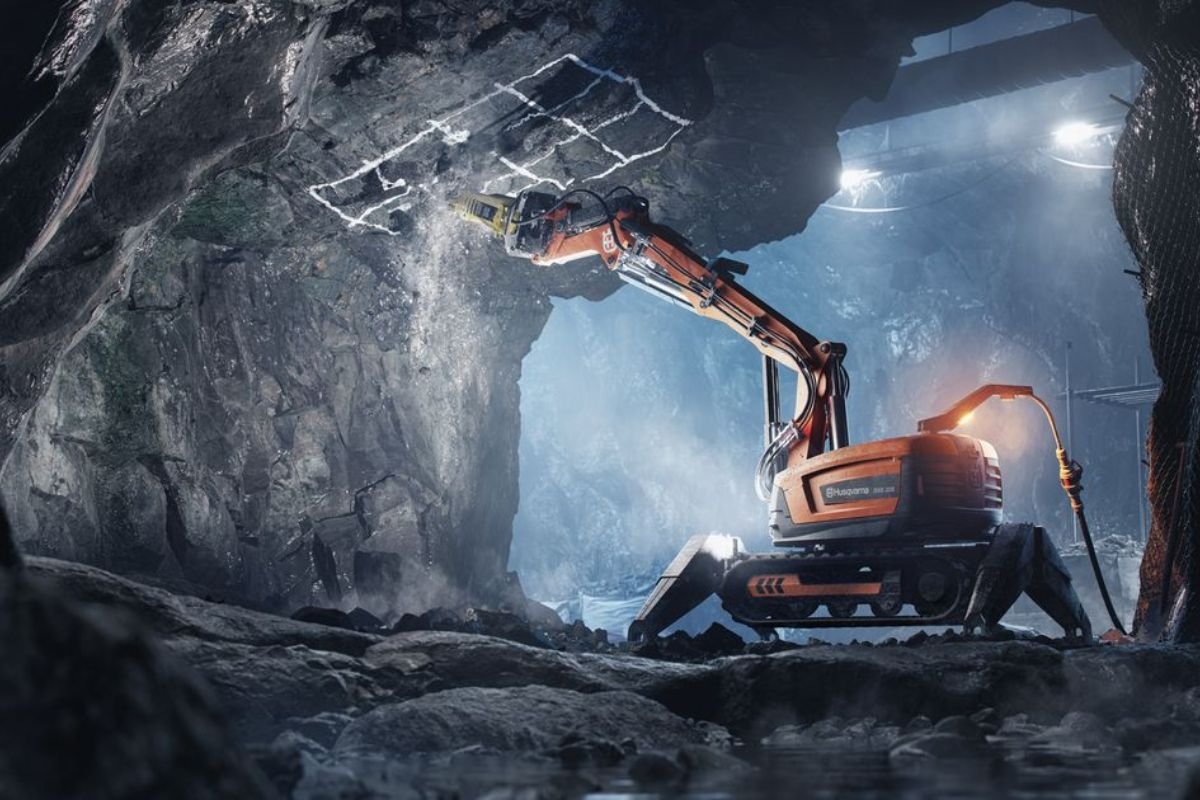
When we think about the future of the extraction industry, the public imagination usually gravitates toward autonomous haul trucks navigating open-pit dirt roads, or AI-driven drilling rigs mapping out untouched veins of copper. However, one of the most dangerous and complex logistical bottlenecks in the entire mining ecosystem happens entirely out of sight, thousands of feet underground.
It is the challenge of the subsurface lift.
Underground mining is an environment defined by extreme spatial constraints. You are not just extracting raw ore; you must constantly transport, install, and maintain massive pieces of infrastructure—from 50-ton rock crushers to enormous steel ventilation beams—through dark, uneven, and narrow tunnels. For over a century, moving these gargantuan weights has required human operators to stand precariously close to suspended loads, relying on hand signals, radio chatter, and intuition to avoid disaster.
But a fundamental shift is occurring. The integration of spatial computing, robotics, and predictive AI is transforming heavy overhead lifting from a blunt-force mechanical task into a highly precise, autonomous operation.
The Spatial Nightmare of the Underground
To understand why autonomy is necessary, you have to understand the environment.
In a modern steel foundry or an open-sky construction site, a lifting operator has the benefit of clear sightlines, abundant lighting, and stable atmospheric conditions. In a deep-vein mine, none of these luxuries exist. Operators must maneuver massive steel components through jagged rock corridors where clearance is measured in inches, not feet.
A momentary lapse in concentration, a misunderstood radio command, or a sudden shift in the payload’s center of gravity can cause a swinging load to strike a tunnel wall. When tens of thousands of pounds of steel violently collide with a rock face, the resulting kinetic energy can trigger structural cave-ins or crush personnel caught in the pinch point. The human error margin is effectively zero.
Removing the Human from the Hazard Zone
The primary objective of autonomous lifting technology is not necessarily to speed up the extraction process, but to fundamentally alter the safety equation.
While traditional cranes for mining have always relied on the sharp eyes and steady hands of veteran operators sitting in cabs or holding pendant remotes, the next generation of lifting equipment operates differently. These systems are being equipped with high-resolution LiDAR scanners, radar, and stereoscopic machine vision.
Instead of a human eyeballing the distance between a suspended rock crusher and a cavern wall, the autonomous hoist creates a real-time, 3D topographical map of the tunnel. The system calculates the exact geometry of the load, maps it against the jagged confines of the environment, and creates a mathematically perfect, collision-free trajectory.
More importantly, it allows the human operator to be entirely removed from the hazard zone. Through tele-operation and autonomous “waypoint” navigation, an operator can supervise the lift from a climate-controlled control room on the surface, safely insulated from the physical dangers of a snapped cable or a swinging load.
The Predictive Maintenance Advantage
The benefits of autonomy extend beyond spatial navigation; they dive deep into the mechanical health of the machinery itself.
Heavy lifting in a subsurface environment subjects equipment to punishing conditions: highly corrosive airborne dust, extreme humidity, and constant heavy-load cycling. Historically, equipment was maintained on a rigid calendar schedule, or worse, repaired only after it broke.
Autonomous and connected lifting systems act as their own diagnosticians. By utilizing an array of IoT (Internet of Things) sensors, the equipment continuously monitors its own vital signs. It measures the micro-vibrations in the gearbox, the thermal output of the electrical motors, and the precise tension on every individual strand of the wire rope.
If the AI detects that a specific motor is drawing 3% more amperage than normal to lift a standard load, it flags the anomaly. The system can predict a mechanical failure weeks before it actually happens, allowing maintenance crews to replace a worn bearing during a scheduled shift change, rather than dealing with a catastrophic, mid-lift failure that traps machinery deep underground.
Conclusion
As the global demand for rare earth metals and base materials accelerates, extraction companies are being forced to dig deeper into the earth than ever before. These deeper environments are hotter, tighter, and inherently more hostile to human life.
Scaling operations safely in this new frontier requires more than just bigger motors and thicker steel cables. It requires giving the machinery the ability to see, think, and react. By handing the most dangerous lifting tasks over to autonomous systems, the mining industry can finally break the historical correlation between extreme heavy lifting and catastrophic human injury.